What's an EPK (and why most of them get ignored)
EPK stands for Electronic Press Kit. In plain English, it's a one-page document you send to journalists, bloggers, playlist curators and gig bookers to tell them who you are, what you've made, and why they should care. Think of it as your song's CV.
The person on the other end is busy, doesn't know you and (whisper it) a little bit lazy. They get hundreds of these. They are not going to dig through three pages of your life story to find the one fact they need. I'm not saying those amazing blog writers don't exist but generally, if they can't find a hook in about ten seconds, they move on to the next one. Brutal, but true.
So the whole game is this: make their job effortless. The easier you make it for them to write about you, the more likely they are to actually do it.
The big mistake people make is writing their EPK for themselves, whilst dressed as a sleazy salesman (look at me, look at everything I've done! Book me Book me!) instead of writing it for the person reading it. We're going to do the opposite.
And if you get bored at any point, feel free to refer to the procrastination area linked here: MixGenie Procrastination Area
In a nutshell: A great EPK isn't the one that says the most. It's the one a lazy journalist can copy, paste, and publish without having to change a single word. But a good one still has everything they need to write something that sounds thought out and genuine. That's the landing zone!
The Anatomy of a Perfect EPK
I want to be clear that this is my way of doing it. There are others, many are valid, some are less valid than others ;)
For me, it's a one page wonder. A snappy, single-page PDF where everything is visible at a glance. Here's the running order, top to bottom, and we'll break each bit down after:
- A photo + your contact details: who do I call, right at the top
- The key release info: song/EP title, release date, and a private link to hear it
- The four-paragraph pyramid: your bio, built so they can take as much or as little as they need
- Track listing: if it's an EP or album
- The artwork: so they've got something to put next to the words
Why one page? Because the moment it becomes two, you've lost them. Everything that matters has to be in eyeshot. If it's not on the page, for our busy friend, it may as well not exist.
Check out these two examples below. One is my old band. One is made up. Guess which!
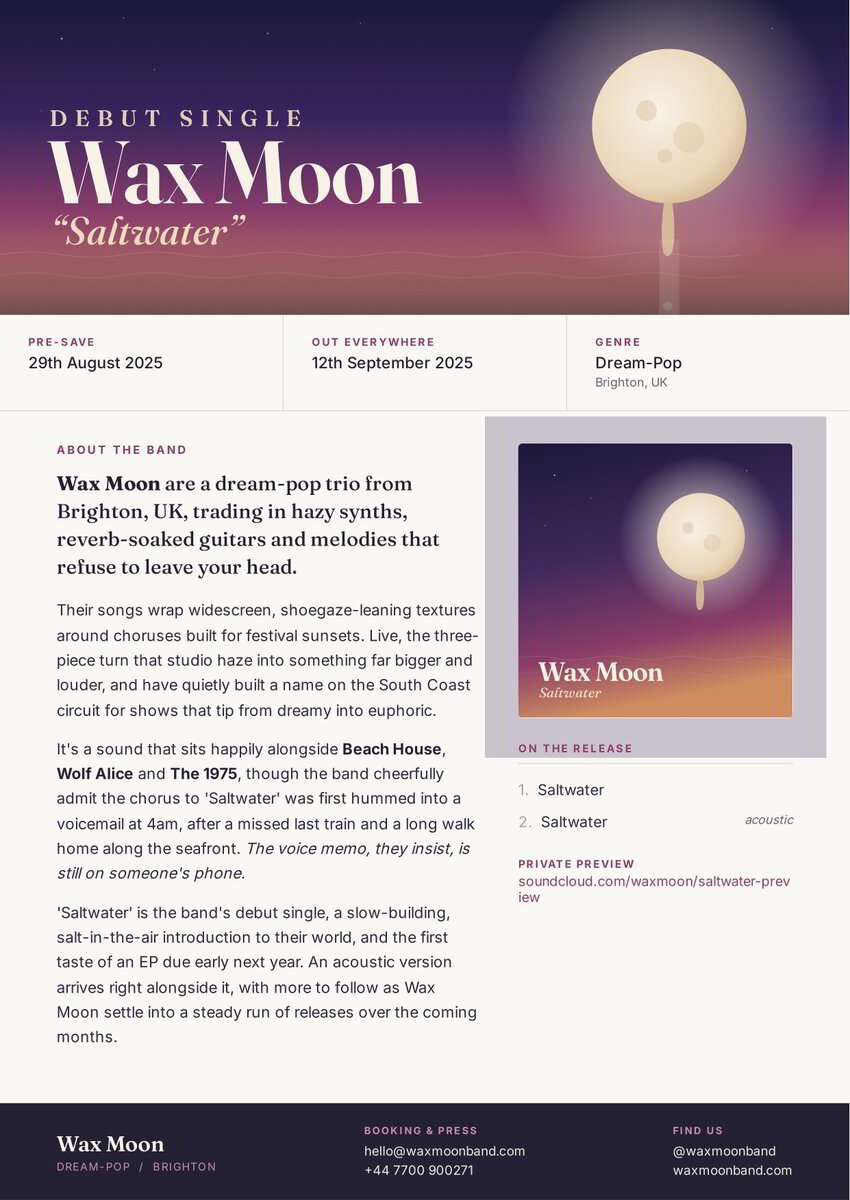
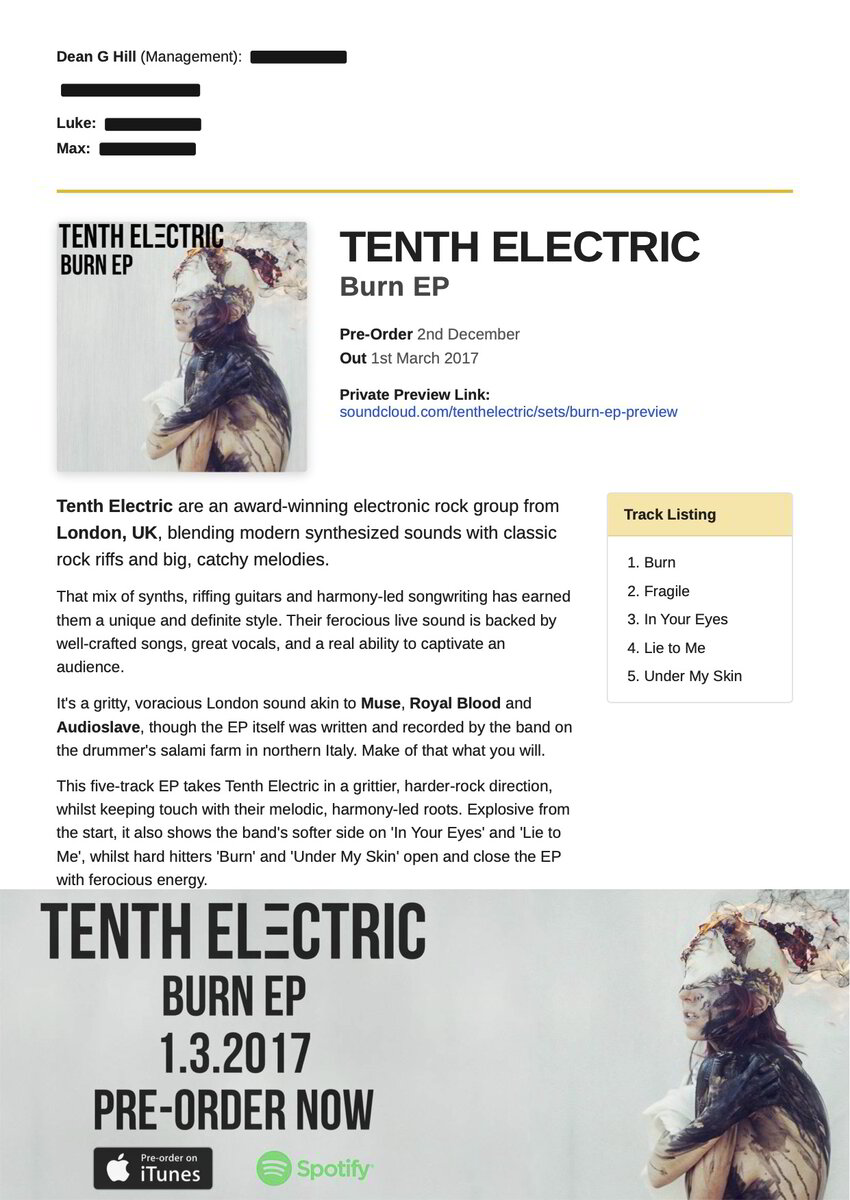
1. The Photo and Contacts
Who do I call? Put it where they can see it
I'm not overly fussed about where it is, but it needs to be absurdly clear how they should contact you. Right at the top, right at the bottom, whatever looks good. Management (if you have any), the key band members, and an email address.
With the imagery, remember that release images are square, so that should be the only square image on the EPK. Other imagery like banners need to avoid being square so that there is no confusion.
I know the examples above don't have this but actually I think in the modern context of ai artists being out there, a crucial factor here is to put a believable picture of you being a human on there. You can see both have banners, I'd put your lovely face somewhere on these. And probably not too airbrushed or your playlist curator might put you straight in their anti-ai prejudice bin.
One working email address beats five half-remembered phone numbers. Use one you actually check. The number of opportunities lost to an inbox nobody looks at is genuinely tragic.
2. The Key Release Info
The facts they need, before they need to ask
Near the image, give them the essential facts of the release in a tight little block:
- The title of the song or EP
- The release date (and pre-order date if you have one)
- A private preview link so they can actually hear it
That private link is doing a lot of heavy lifting. A blogger isn't going to write about a song they can't hear, and they're definitely not going to email you asking for it. Pop a private SoundCloud link (or similar) right there so they can press play in two seconds. Make it private/unlisted so it's not floating around the public internet before release day.
REMEMBER TO LOG OUT AND TEST YOUR LINKS!
Everything in this block answers above should a question they'd otherwise have to email you to ask. Every question you answer up front is one less reason for them to give up and move on.
3. The Four-Paragraph Pyramid
The Clever bit. Write it once, let them take what they need
This is the heart of the whole thing, so pay attention.
Your bio is written as four paragraphs that each build on the last. The trick is that each one can stand on its own, or be stacked with the others.
Why does that matter? Because different people have different amounts of space. A gig listing might only want two sentences. A full feature might use the lot. By building it as a pyramid, you let them grab exactly as much as they need without having to rewrite anything. One, two, three or four paragraphs, whatever fits their slot. If you do this right and it sounds good, you are literally writing your own copy that gets published.
The golden rule: write it so it sounds like something they could have written themselves. Not salesy, not boastful, no breathless marketing nonsense. If it reads like an advert, they can't lift it. If it reads like good journalism, they'll paste it straight in and move on with their day. That's the dream.
Paragraph 1: The Tagline
Two sentences, max. Who you are, where you're from, and the hook. "Tenth Electric are an award-winning electronic rock group from London." Done. This is the bit that has to work entirely on its own, because it's the bit most people will use. If you only nail one paragraph, nail this one.
Paragraph 2: The Sound
A little more depth. What do you actually sound like? What's the live show like? This sits in tandem with paragraph one, and together they give a tidy, slightly fuller picture. Still no waffle. Every sentence earns its place.
Paragraph 3: The Context (and the human hook)
Add your reference points here, the "sounds a bit like Muse, Royal Blood and Audioslave" type line that instantly tells someone what shelf you belong on.
And this is also where you slip in a bit of humour, a quirk, or a factoid. People love this, and crucially, it gives a journalist their angle: a ready-made bit of colour they can build a sentence around. A good odd detail is the thing that ends up in the actual write-up.
For example: "The drummer once toured with [So-and-So]… before kicking him out of the band for his poor hygiene." That's the kind of detail a blogger will happily run with. It's human, it's funny, and it makes you memorable instead of just another act in the inbox.
Paragraph 4: The Release and the Direction
The final paragraph is about this release specifically (what it is, what it's about) and where you're heading as an artist. It rounds the picture off for anyone running the full-length piece, and gives a sense that you're going somewhere (which is exactly what a journalist wants to hitch their wagon to).
Remember the shape: paragraph 1 stands alone. 1+2 work as a pair. 1+2+3 add colour and context. All four together give the full story. You write it once. They take what they need. Everybody's happy.
4. Track Listing and Artwork
The finishing touches that make it feel good
If you're releasing an EP or album, pop a simple track listing in a little sidebar or box. It's quick, it's scannable, and it tells people exactly what they're getting. For a single, you can skip this.
Then there's the artwork. Include your cover art or a release poster on the page. A blogger writing about you needs an image to put next to the words, and if you hand them a good one, they'll use it. If you don't, they might just… not bother. Give them the picture so the choice is made for them.
Make sure your artwork is good quality and actually represents the music. It's often the very first thing someone sees, and first impressions are doing more work than you'd like to admit. Please Please Please avoid lo-effort ai artwork, it's the quickest way to have your song chucked in the bin!
5. One EPK, Many Inboxes
Yes, you can get away with just the one
You might be wondering: don't journalists, bloggers and gig bookers all want different things? A booker cares about your live draw, a journalist cares about the story, and so on. And you're right, they do, up to a point.
But because your EPK is built as a pyramid, one well-made EPK serves all of them.
Each person simply takes the bits relevant to them and ignores the rest. You could make tailored versions for different recipients, and occasionally that's worth it, but for most releases, one strong, modular, one-page EPK does the job. It's far easier, and easier means it actually gets done.
Don't let perfect be the enemy of done. One brilliant one-pager you actually send beats five tailored versions sitting half-finished on your desktop.
The EPK Checklist
Run through this before you hit send
- It fits on one page. (No, really. One.)
- Photo and contact email are at the top (or bottom) and easy to find
- Title, release date and a private preview link are all there
- Paragraph 1 works as a standalone two-sentence tagline
- Each paragraph builds on the last and could be lifted on its own
- There's a human hook, a joke, quirk or factoid, in paragraph 3
- It reads like journalism, not an advert (could they paste it in as-is?)
- Track listing and good artwork are included
- You've spellchecked it. Twice. A typo in your EPK is a bad look, especially when the dyslexic gig booker publishes it!
Final check: if you were a tired blogger at 11pm with 23 of these to get through, could you write your piece using nothing but this page? If yes, you've nailed it.
OK, that's everything. Now stop overthinking it and go and build the thing. Your music deserves to be heard by more than your mum and your dog. YOU GOT THIS!
I really hope this helps. If you've got questions, or think I have left something out, do get in touch over on the website and I try to respond to everything. And if you'd like a hand getting your song release-ready before it goes out, that's exactly what I do, all day, everyday!
Couldn't AI do this for me?
Ah, so you're also feeling lazy eh?
You've read to the end, and then you kept scrolling wondering if you can get a robot to do the actual writing. And the answer is: yes, absolutely. A tool like ChatGPT or Claude will happily knock out your four-paragraph pyramid for you, and do a decent job of it too.
But here's the downside, and it's an important one. An AI can only work with what you give it. It doesn't know your band name, where you're from, what you sound like, or that brilliant story about your drummer. If you just ask it to "write me an EPK", you'll get bland, generic mush that reads like every other AI-written EPK in the inbox. It won't do the paragraph thing and it will probably have a bunch givaway ai tropes like long "— em dashes" (like seriously I can't even find this on my keyboard! Had to google it and copy the symbol!. Ai loves them and trust me, journalists can smell that a mile off.
The trick, if you want to cut out the creative fun of writing your own, is to make the AI interview you first. Get it to ask you the right questions (your name, your sound, your reference artists, your human hook, your release details) and then write the pyramid using your actual answers. That's the difference between generic filler and something that sounds like you.
To help with this, I (actually I got claude to do it) have written a ready-to-go prompt that does exactly that. It tells the AI how to structure everything we've covered in this guide, gets it to ask you all the right questions, and then writes your EPK copy in the proper modular pyramid. You just paste it in, answer the questions, and away you go.
One last word of advice though: even with the AI doing the heavy lifting, give the result a read and definitely tweak it before you send it. Make sure it actually sounds like you, fix anything that feels off, and double-check your facts. The robot's a brilliant assistant, but you're still the artist.
Now go on, off you pop!